
Crushing the #10 Can Tax: How Modern Kitchens Are Cutting BOH Friction
As food costs continue their relentless climb, one truth is clear: You can’t keep raising menu prices without risking customer loss.
Eighty-five percent of operators watched their food costs jump over the past year, with 40% admitting they’re “just getting by right now.” Nearly 70% say there’s less room for error in pricing decisions, and 58% fear losing customers if they raise menu prices any further,1 making internal operational efficiencies more critical than ever.
Waste reduction offers a direct line to margin relief. Seventy-seven percent of operators agree that cutting waste saves real money, 67% focus on waste reduction to boost profits, and 48% do so to streamline kitchen efficiency.2
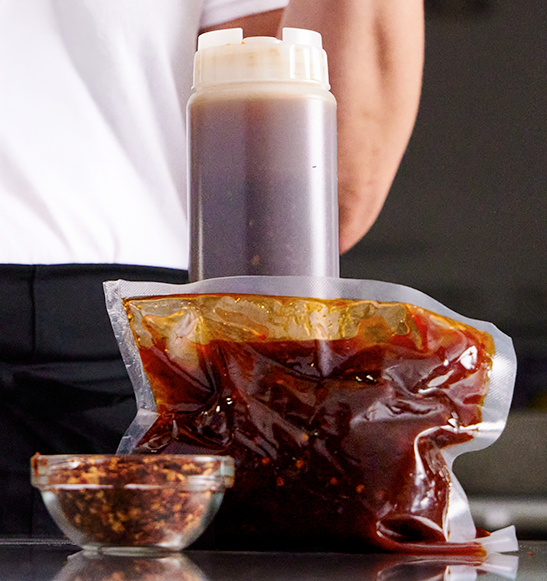
For modern kitchens, the legacy #10 tin can incurs hidden taxes across labor, safety, storage, and waste. Switching to flexible pouch packaging — like Kagome’s line of pouch-packaged sauces and culinary bases — eliminates these frictions, giving you control over cost management and back-of-house performance.
The Trash Tax
Every time your waste management company pulls up to empty the dumpster, you’re paying twice: once for volume and once for weight. Supplier packaging and non-food materials make up nearly one-third (32%) of a restaurant’s total weekly trash volume, leading 30% of operators to actively seek ways to shrink waste volume and lower dumpster fees.2
Food waste costs operators between $1,500 and $2,000 per ton when adding up lost purchasing dollars, labor, and hauling fees.3 Steel cans exacerbate this problem by adding unnecessary mass and rigid bulk to your waste stream. Flexible pouches drastically change the math: They reduce primary packaging waste volume by 85% and weigh 90% less (one-tenth the weight) than a #10 metal can.4 This reduction directly slashes waste disposal costs while achieving tangible sustainability goals that resonate with today’s environmentally conscious diners.
The Storage Trap
Square footage in a modern commercial kitchen is high-value real estate. For operators buying in bulk to secure lower unit prices and fight inflation,2 dry-storage shelves fill up rapidly, further limiting their storage space.1
Rigid cans force you to pay for fixed container volume regardless of shelf layout, leaving cooks scrambling for prep and holding space. Kagome’s flexible pouches solve this storage crunch by taking up 40% less storage space than rigid metal cans for the exact same volume of sauce.4
By eliminating the air and rigid structure of metal containers, pouches allow kitchens to maximize existing shelf space, improve inventory visibility, and keep storage areas organized.
The Safety Risk
Handling #10 cans is a daily physical hazard for kitchen staff. Prep cooks haul 50-pound cases of metal cans, crank industrial openers, pry off razor-sharp lids, scrape inner rims, and apply foot or arm force to crush rigid steel cans so dumpsters don’t overflow.
The financial footprint of these routine hazards is substantial:
- Cuts and lacerations account for 25% of restaurant workers’ compensation claims ($1,798 average claim cost),5 occurring at a rate three times higher than the national private industry average.6
- Sprains and strains from heavy lifting and repetitive motions represent 36% of all restaurant injuries,6 with a single claim averaging $9,966 to $10,672 — more than five times the cost of a cut claim.5
- At a fully loaded labor cost of ~$21.00 per hour, burning 15 to 20 minutes per shift on can logistics wastes over $1,300 a year per cook in pure friction time.7
Kagome pouches weigh 90% less when empty,4 ship flat, require no heavy box hauling, tear open instantly, and collapse effortlessly into the trash without manual crushing.
The Scrape Loss
Beyond labor and safety concerns lies direct product loss inside the container.
Between 3% and 10% of viscous foods are routinely thrown away simply because they cannot be easily extracted from rigid containers.8
On a standard $50 case of canned paste or sauce, a 3% to 10% loss equals $1.00 to $5.00 of usable product thrown into the trash per case. For a kitchen utilizing 10 cases a week, that invisible drain adds up to $2,600 a year in lost food spend.
When 67% of operators are actively cutting waste to lower food costs, and 29% are resorting to less expensive ingredients to protect margins,2 throwing away premium sauce is an avoidable loss. Squeezable pouches allow cooks to roll down the flexible film and extract virtually 100% of the sauce in seconds, with zero scraping required.
The Shared Strategy
Operators are actively seeking practical suppliers who can help protect their margins. Industry research indicates that 47% of operators think food manufacturers are not doing enough to help them cut waste,2 and 58% agree their suppliers should actively work with them to find lower-cost, higher-efficiency alternatives.1
Fifty-five percent of operators say they would switch suppliers if they could secure better overall pricing or cost efficiency elsewhere.1
From a supply chain perspective, the efficiency gains of flexible packaging extend well beyond the kitchen door: One truckload of pouch-film rolls carries the equivalent packaging volume of 15+ truckloads of empty rigid metal cans, while using 75% less energy to manufacture.4
Partnering with pouch-packaging suppliers delivers the high-efficiency, cost-conscious solutions operators demand.
The Bottom Line
Replacing legacy #10 metal cans with flexible pouch packaging is not an abstract green initiative. It’s a high-ROI back-of-house upgrade that reclaims 40% of storage space,4 eliminates costly safety hazards, slashes packaging trash volume by 85%,4 and keeps thousands of dollars of product out of the dumpster each year. For operators looking to protect tight margins, switching to flexible pouches is a clear operational win.
Looking to cut the BOH friction? Schedule an ideation session with Kagome today.
Sources
- Datassential, Operators Navigating Higher Prices, March 2026
- Datassential, Food Waste: The Operator Perspective, August 2025
- ReFED Insights Engine and Food Waste Monitor
- Kagome USA, “Can vs Pouch” Specification Guide, 2026
- AmTrust, Restaurant Risk Report, 2024
- Bureau of Labor Statistics/OSHA, Full-Service Restaurant Injury Data, 2019
- Bureau of Labor Statistics, Occupational Employment and Wage Statistics, May 2025
- GreenBlue/Sustainable Packaging Coalition, Designing Packaging to Prevent and Divert Food Waste, 2023


